
How Bamboo Grows
Bamboo is one of the fastest-growing plants on earth. Here’s how a young planting fills in — season by season — into the lush, evergreen privacy screen you’re after.

Bamboo doesn’t grow like other plants — and that catches almost every new grower off guard. The cane you plant won’t get any taller. Instead, each spring a brand-new, bigger cane rockets up from the roots, sometimes growing up to 4 feet in a single day. Once you understand that rhythm, everything your bamboo does starts to make sense.
Every year we hear from customers worried that their new bamboo is “just sitting there.” It isn’t — it’s busy building the underground root system that powers the explosive top growth to come. Bamboo didn’t earn the title fastest-growing woody plant on earth for nothing.
How to start growing bamboo
Start with a plant, not seeds. Temperate bamboo only seeds on roughly 75-year cycles, and that seed is rarely viable — chasing it is a poor use of your time and money. More about bamboo seeds →
It’s important to realize that the division you begin with only grows underground. The cane (culm) attached to the rhizomes has finished growing; from now on it simply feeds the root system. Don’t expect it to get taller or thicker. Each spring, a new cane emerges at the full diameter it will ever have and reaches its full height in just a couple of months — the entire life cycle of a cane plays out in one short season.
The bamboo growth cycle
Here’s what happens after you plant, year by year:
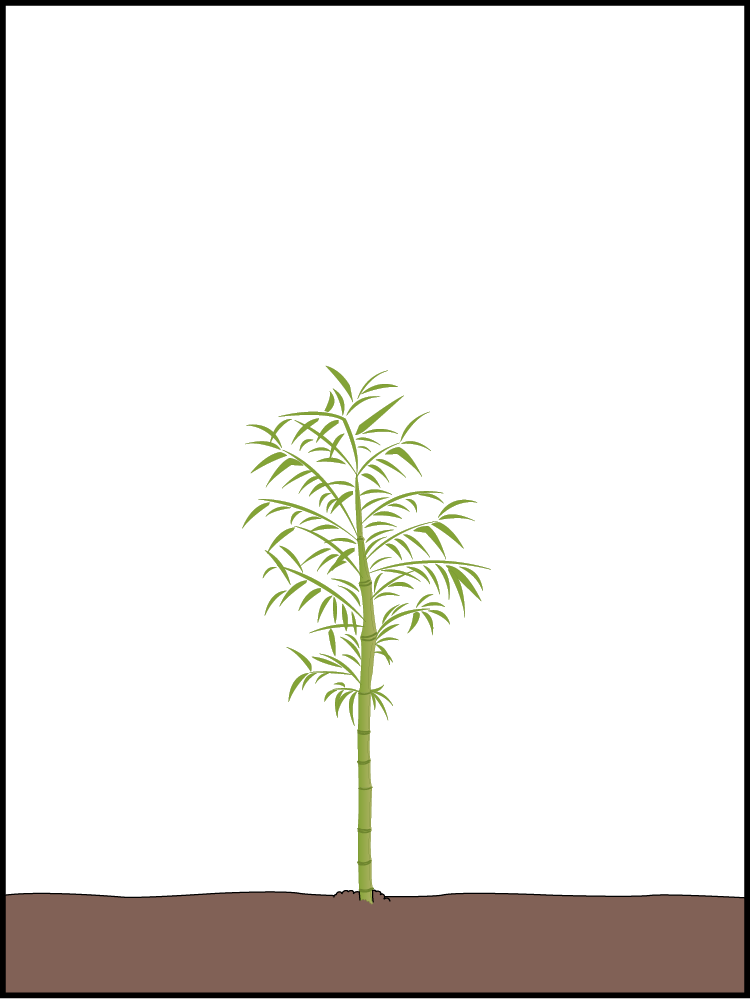 Initial planting
The division you plant never grows taller or thicker again — its job now is to feed the root system.
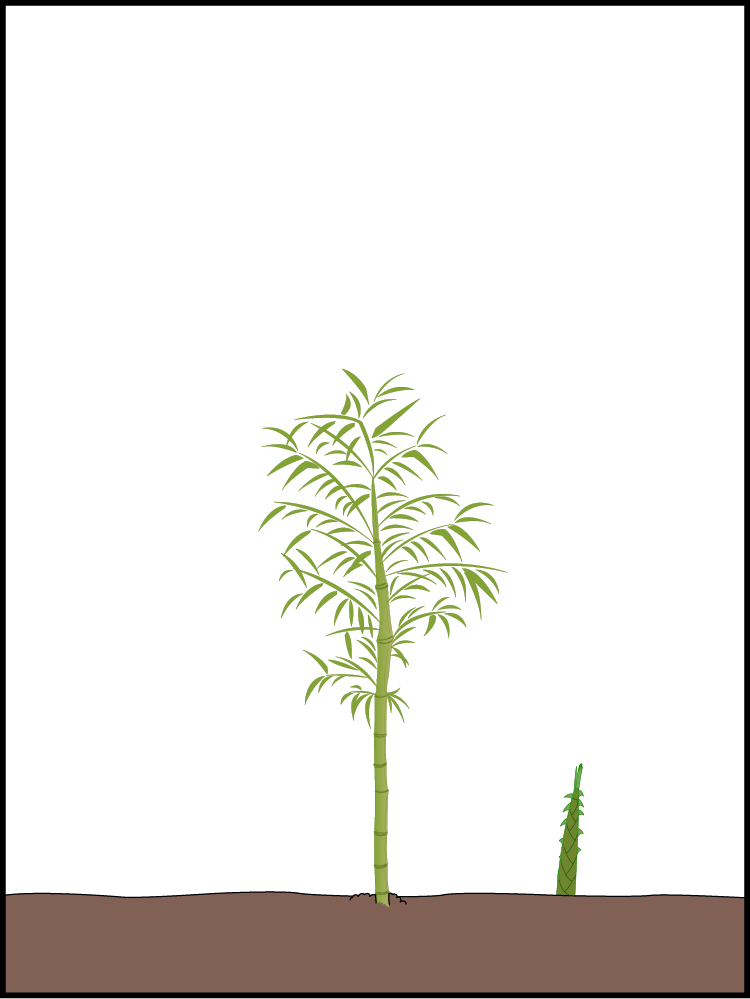 First spring
New shoots emerge from the roots and can grow up to 4 feet per day.
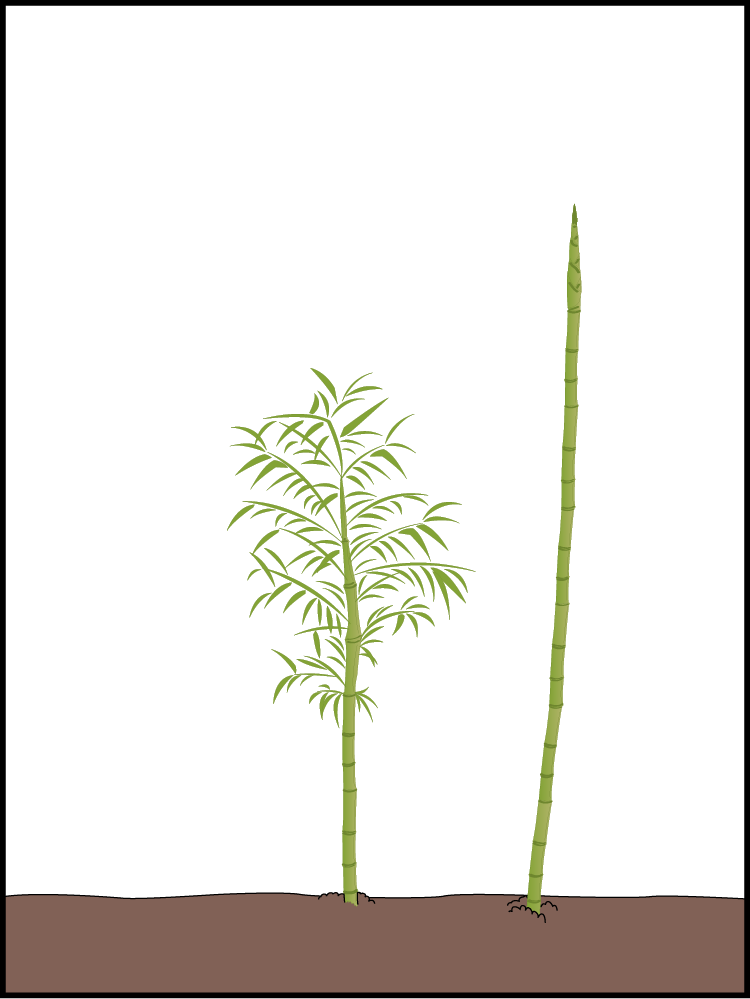 Late first spring
Each new cane completes its full height in about 60 days, then stops for good.
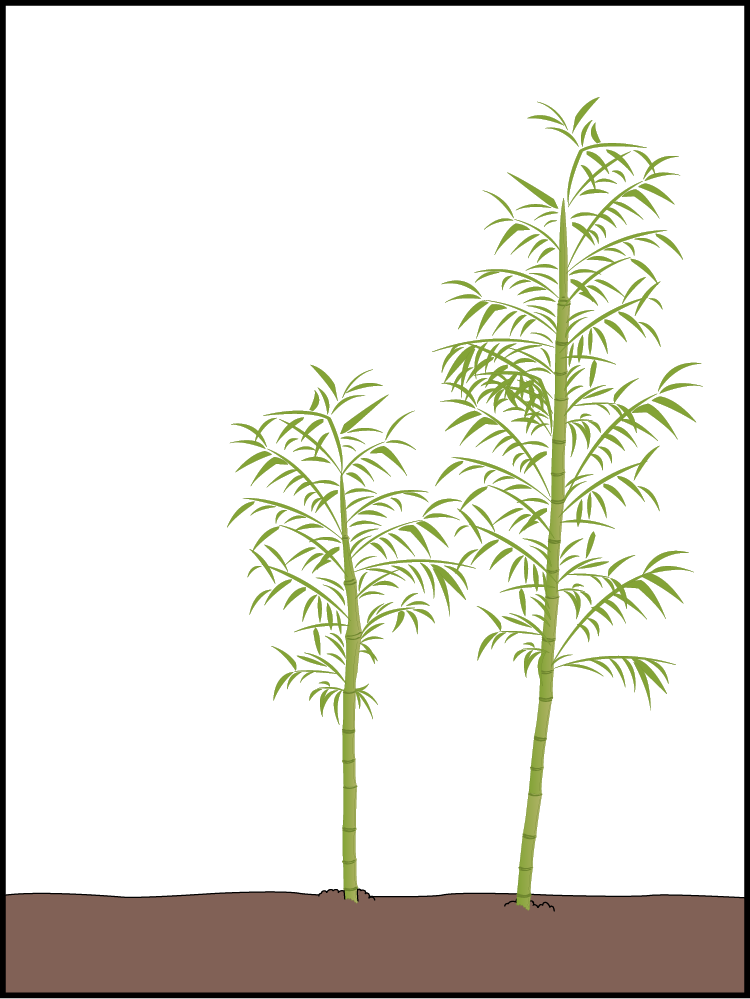 First summer
Once that 60-day sprint ends, the cane is finished growing — permanently.
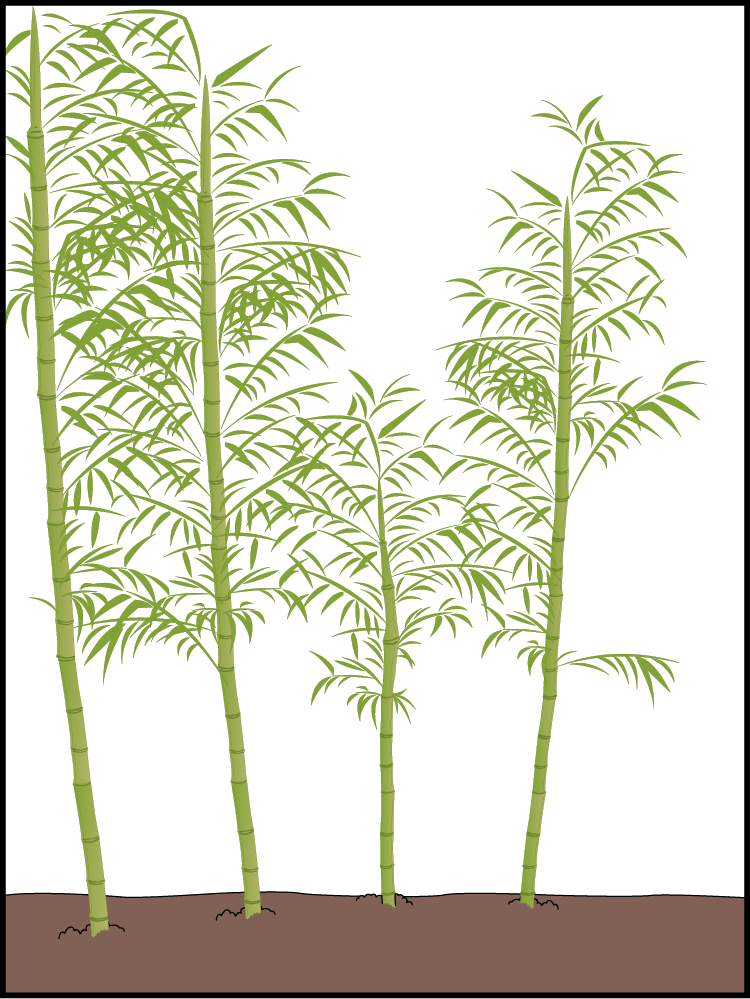 Second summer
The grove channels energy from existing canes into bigger, more numerous spring shoots.
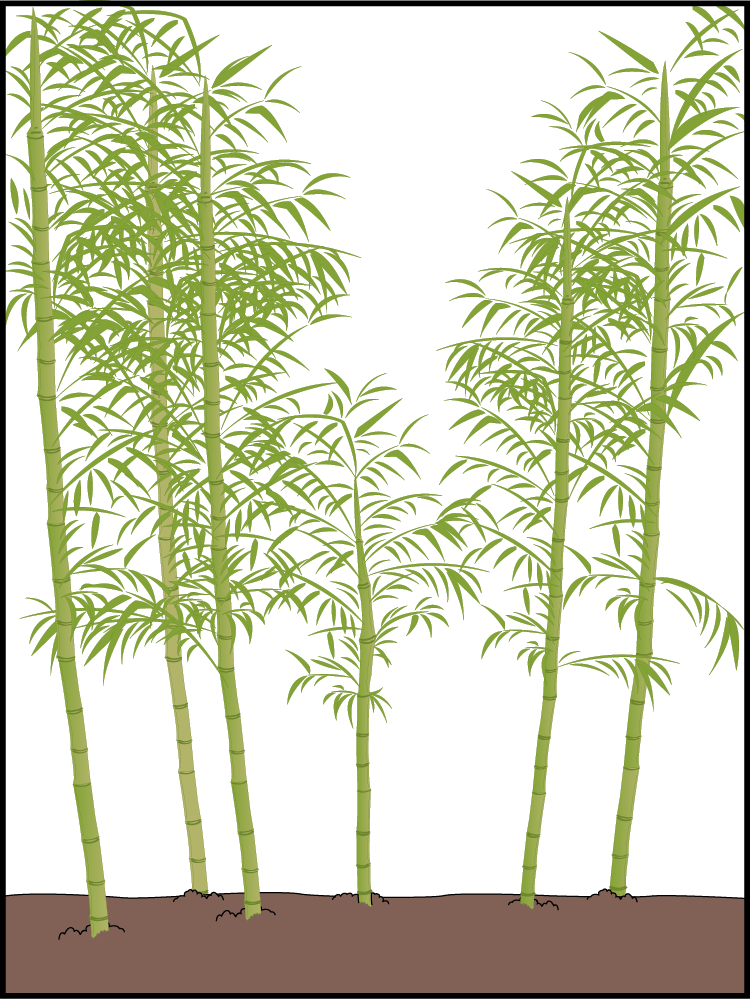 Third summer
Compounding growth takes over — larger canes every year until maturity at 7–10 years.
What determines how big new shoots get?
Shoot size depends on the size of your initial planting, the species, the age of the grove, and the growing environment. Your starter should always be a healthy division from an established grove.
Think of your first plant not as a single specimen but as the beginning of a colony. About half of a bamboo grove’s mass lives underground as rhizomes — roots that look much like miniature canes, complete with nodes and internodes. New roots and rhizomes grow from those nodes, storing the nutrients that let the grove push out larger canes each year until it reaches mature size.
A young grove is a bit like a child: it won’t show all of its parents’ traits right away. Your new division may not yet have the stripes, leaf size, or color of a mature plant — those characteristics develop with time. That’s exactly why it pays to buy from a reputable source.
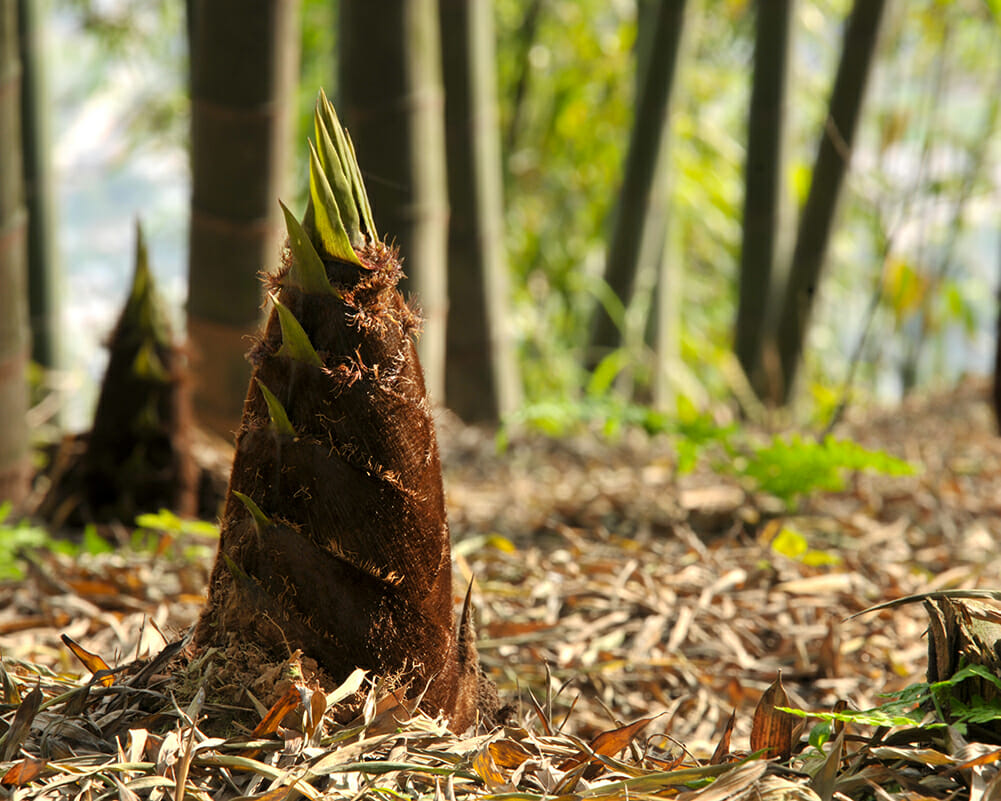
New growth
In spring, new canes emerge upward from the rhizome nodes. These shoots are extremely tender — the slightest bump can snap one. Each emerges at the diameter it will keep for life, then grows at an astonishing rate for 40 to 60 days.
Bamboo extends much like a telescope. Its growth has been measured at almost 4 feet in a single 24-hour period during the spring shooting season. When a new shoot reaches its full height, it unfolds its branches and leaves — even though that cane will never grow taller or thicker again.
When does new growth emerge?
For Phyllostachys bamboo in the Northern Hemisphere, new shoots typically initiate around March and continue through May. The exact timing varies a little by species and local conditions.
How to make bamboo grow faster
Bamboo is already the fastest-growing plant on earth — but you can absolutely help it along. Here are the levers that matter most.
Start with a big, established plant
The larger the plant you start with, the larger its rhizome system — and the faster it produces big, numerous shoots. Bamboo is a colony plant, so more (and larger) rhizomes mean better growth. You can’t shortcut the time a species needs to establish its roots, but starting with a healthy, stabilized division gets you there sooner. Avoid freshly dug plants — that’s the most unstable moment, just after they’ve been cut from their energy source.
Soil conditions
Bamboo isn’t picky about soil, but it’s happiest in neutral (pH 7), sandy loam with plenty of organic matter and good drainage. It will still do well in clay and less-than-ideal soils. Bamboo roots are shallow — most feeding happens in the top 12 inches — and they won’t tolerate standing water, which can rot the system within a few weeks. (Don’t confuse true bamboo with “lucky bamboo”, which is actually a lily and grows in water.)
Sunlight
More sun means more energy for photosynthesis and growth. Most bamboo wants at least 4 hours of filtered sun or better. A smaller group of large-leaf, shorter species (20 feet or less) prefers partial shade — but that’s the exception, not the rule.
How many plants do I need?
Bamboo grows by compounding, so planting several divisions dramatically increases how much you’ll have each year and shortens the time to a screen or grove. You can establish a grove from a single good division — it’ll just take longer.
For a screen or grove in a hurry, plant on 5-foot centers or closer — that often delivers a screen in 3–5 years, and the larger your starting size, the taller that screen will be. Closer spacing fills in faster, and you really can’t over-plant bamboo.
Should I fertilize?
Yes — fertilizing can accelerate growth by a year or more. It’s the single best way to speed things up. Because soils vary and bamboo is so eager to grow, we recommend a well-balanced, time-release fertilizer.
What to expect from your grove
It takes about three full years in the ground before the mother plants really take off and start producing the multiple shoots that read as a true “grove.” Under normal conditions, from a 3-gallon Phyllostachys you should see a couple of new canes the first spring; the next spring each of those can produce a couple more; and by the third year, compounding growth becomes unmistakable. After three full years it gets impressive fast — each spring’s new canes emerge taller and thicker than the last.
The first three years
Whatever size you start with, the mother plant is finished growing in height and diameter — but its rhizomes keep spreading underground. Each spring, the new canes emerge larger than the previous year’s, until the species reaches its mature size. The oldest canes are usually the smallest; the newest are the biggest, thanks to the ever-expanding root system beneath them.
Controlling bamboo
Because temperate running bamboo so rarely sets seed, it spreads almost entirely by rhizome expansion and new cane production. So if you control the roots, you control the bamboo.
You can root-prune twice a year, or install Bamboo Shield for a worry-free barrier. Bamboo Shield lets you define exactly where bamboo may grow — long privacy screens or custom shapes. Installation is straightforward wherever you can dig: cut a trench around the area and set the barrier vertically to block the rhizomes. Bamboo has no deep taproot; its roots run parallel to the surface, usually within the top 14 inches of soil.
Bamboo is a grass, and a little maintenance keeps it as a tidy screen or contained grove. It will not “take over the world” — if that myth were true, it would have happened millennia ago. With occasional root-pruning or a Bamboo Shield barrier, you’ll get the fast-growing, evergreen privacy only bamboo can provide.
Bamboo anatomy
Bamboo is a monocot — hollow stems with scattered vascular bundles and parallel-veined leaves. Those woody, ringed vertical stems are called culms (or canes). The most common temperate bamboos belong to the genus Phyllostachys, recognizable by a groove (sulcus) above each branch and two alternating limbs at every node. It’s the silhouette most people picture as “bamboo,” but the variety is enormous: some species have colored sulcus stripes, yellow canes with green stripes (or the reverse), black or spotted canes, three or more limbs per node, and every imaginable leaf color and variegation.
Bamboo is evergreen and puts on new leaves every year, mostly in spring. You’ll see a carpet of golden-brown old leaves drop within the grove — leave it in place; it mulches and feeds the colony. Because bamboo holds its leaves year-round, it screens in every season.
Bamboo & cold weather
Our cold-hardiness figures come from the American Bamboo Society’s Source List, refined by our own decades of hands-on experience. We study and observe our plants constantly to keep this data as accurate as possible.
Many bamboos survive even after exposure to temperatures below their listed hardiness. It can be alarming to watch foliage or canes die back in extreme cold or wind chill — but in most cases the grove bounces back the following spring with new culms and fresh foliage, often on canes that looked dead.
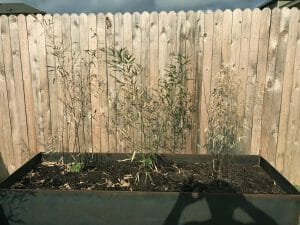
Always match the species to your climate zone and application. One important note: containers and planters don’t insulate roots the way the ground does, so if you’re planting in a pot, choose a species rated several zones hardier than you’d need in-ground.
Bamboo applications
Over 200 species grow well across North America, depending on your climate zone. Bamboo adds winter greenery, stabilizes embankments and controls erosion, and makes a superb privacy screen or windbreak — and you can trim it to the height you want. We carry a species for nearly every application, in a wide range of sizes, colors, and cold-hardiness ratings.