Bamboo Barrier


Home Bamboo Information News Photos Specials Order


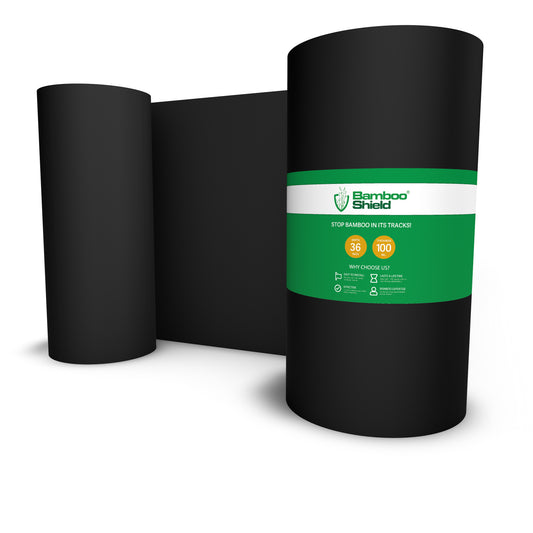
In the above photo you can see some six rolls of barrier wrapped

and awaiting UPS pickup.


     Bamboo makes an ideal garden plant and grows quickly to provide privacy and beauty. There are many ways to control bamboo. On this page we cover the use of an in ground plastic root barrier. If you wish to know the other methods please visit our Growing Habits Page which cover several other methods. Many designers and contractors are nevertheless hesitant to recommend bamboo to clients unless a root barrier is installed.

     We have been the southeast distributors for DeepRoot since 2001 and have had many satisfied customers. We now stock large quantities of this great product. If I cannot answer all your questions a representative from DeepRoot can.  If you find a better price, just forward the company and price they quoted, we will do our best to beat it. While we have used this product and found it to be very effective to contain many species of bamboo your application and results may differ. Follow the instruction sheet provided with each order and root prune any rhizomes that spread outside or over the barrier contained area.

     DeepRoot rhizome barrier has proven to be an effective material to prevent the unwanted spread of bamboo. The smooth surface of the rhizome barrier acts as a root stop, diverting the rhizome and preventing rampant growth. The rhizome will turn and continue to grow along the surface of the barrier. This helps contain the bamboo and aids in preventing the unwanted spread. The barrier is a thick plastic (HDPD) based material. As you may know already plastic is not biodegradable, therefore a thick plastic will last a very long time underground.

At the bottom of the page you can read about DeepRoot's extensive testing.

     We have done studies with many other sources and found that the 30 mil or 0.76mm is great at diverting bamboo rhizomes. Why pay more for thicker plastic barrier when all it has to do is divert the rhizome. If a vendor has 40 or 60 mil barrier that is what they try to sell you. We stock 40 mil also, but I do not push it. We can stock any thickness we desire, but have found the 30 mil to be all you need to divert rhizome growth so why pay more.

BARRIER WORKS BEST AS A  DIVERSION  TYPE CONTROL METHOD WITH A
 VERY SMOOTH SURFACE ON THE SIDE FACING YOUR BAMBOO PLANTING.

     Plastic thinner than 30 mil has been shown to crack when ground temperatures 24 inches deep get below -15 degrees F.. This would be extremely cold and the 30 mil does great at handling very cold temps. without damage. Barrier an inch thick would not crack either, but why pay the cost when the results are the same. The plastic barrier will not crack when frozen like other materials, even concrete will freeze and crack over the years. I know you all have seen concrete driveways with cracks in them. Driveways are poured 4 to 6 inches deep to allow heavy vehicles passage and parking. Concrete was used many years ago ( Byron Agriculture Station in Byron, Georgia) as a below ground barrier system and found to crack below the frost line allowing bamboo rhizomes to emerge through to the other side. One of the many myths of bamboo is its ability to crack solid concrete. While a clumping type bamboo may do this, given enough years, a running type bamboo just runs and does not usually apply the outward pressure of a clumping bamboo or hardwood tree.

      Bamboo is not magical, but persistent and its root system will eventually find cracks in concrete and emerge through them. If the environment ( sunlight & soil ) is suitable once it emerges the bamboo will grow if not terminated. The rhizome ( root ) when growing is very soft and flexible and will always turn when it encounters something harder.  Furthermore, installation of a barrier will accelerate the grow of a bamboo screen.  The growth will be more dense because of the confinements and stimulate the screening effect.

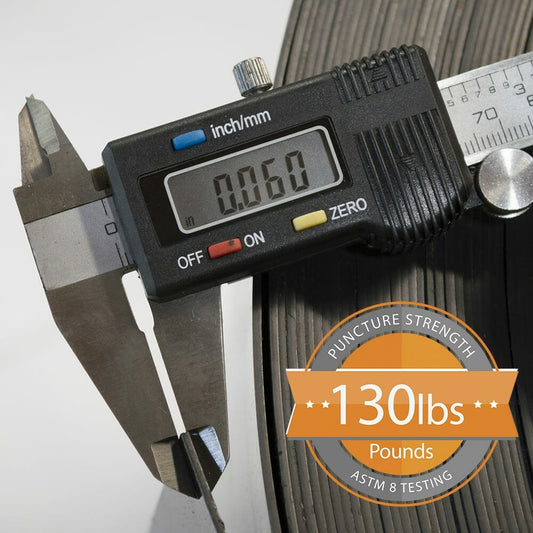
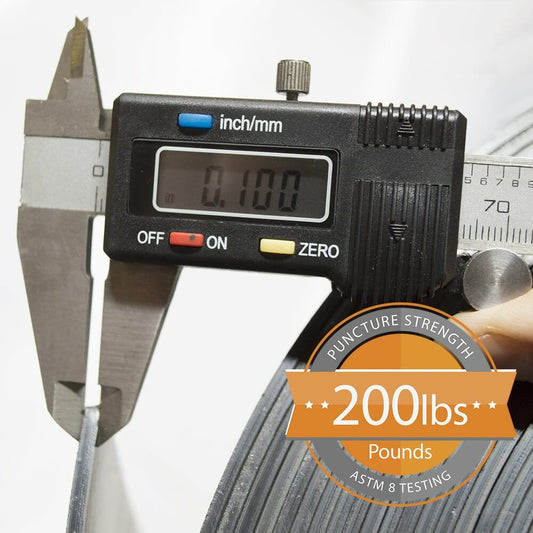
The 30 mil Polyethylene is 0.030" (0.76 mm) thick and has been made from recyclable sheet material.


            Installation:

            Most bamboo will be sufficiently contained using a 24" deep barrier.

            Determine the extent of the area to be given over to the bamboo. Dig a trench around the entire area
            and place the barrier inside.

            1.  Place the barrier into the trench with the shinny or glossy side toward the bamboo. Overlap the ends of the
            barrier by 4 feet and apply a sealant tape vertically on inside and outside of planting area.

            2.  Place the top edge of the barrier approximately 1 inch above the finish grade. This will deter
            overgrowth and make annual maintenance easier.

            Plant according to the standard bamboo nursery planting directions paying attention to soil
            deficiencies, drainage and compacting. Be sure the planting area still drains well or the root
            system will rot.

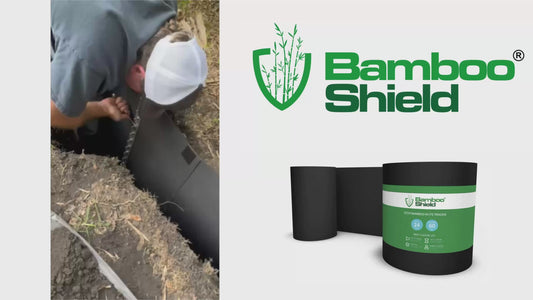
Click here to see some pictures of installation 


            Maintenance:

            Annual maintenance is a key to controlling bamboo even with a root barrier.
            Rhizomes spread outward from the center of the plant in late spring, summer and fall. Each December when
            rhizome activity has ended clear the top edge of the barrier and inspect for any rhizome over-growth. If any
            rhizomes have gone over the top of the barrier cut them off and pull them out of the ground. If this procedure
            is done annually the rhizome are new, soft and easy to remove.


Rhizome barrier is sold by the linear foot.
Barrier can be up to 300 feet uncut, if less is purchased then it has to be in increments of 25 feet.


We do not cut to odd lengths, so the  barrier must in lengths of 25 feet, 50, 75, 100, 125, 150, 175 and  so on to 300 feet  uncut.

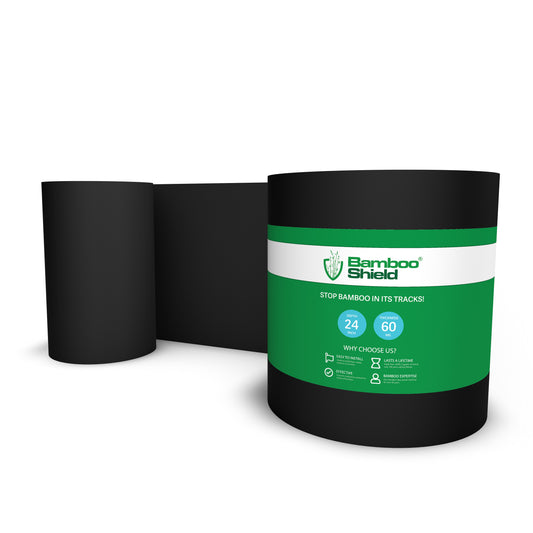
We stock the 24 wide 30 mil barrier in large quantities.

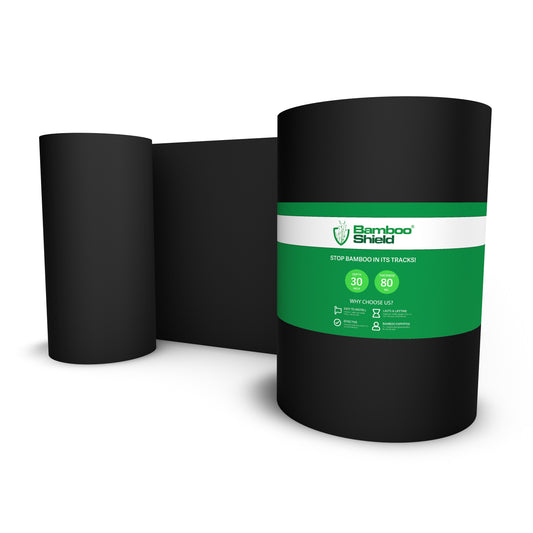
We stock limited quantities of the 30 inch wide barrier in the 30 mil thickness.

We stock the  40 mil in 24 inch widths for those wanting extra thickness.


Sealant tape is provided free with any barrier order, but you do need to request it.

Barrier is sold in 25’ increments. Our 30 mil by 24 inch wide is $1.50 per linear foot. Below is the cost of the barrier including S&H charges. This is shipped to anywhere in the U.S. except Alaska and Hawaii.

25 feet $45.00
50 feet $87.00
75 feet $130.00
100 feet $171.00
125 feet $212.00
150 feet $247.00
175 feet $292.00
200 feet $341.00
225 feet $385.00
250 feet $425.00
300 feet $510.00

Our 30 mil by 30 inch wide is $2.00 per linear foot; the additional cost is packing and UPS shipping cost. This is shipped to anywhere in the U.S. except Alaska and Hawaii.


25 feet $72.00
50 feet $128.00
75 feet $183.00
100 feet $246.00
125 feet $298.00
150 feet $358.00
175 feet $414.00
200 feet $455.00
225 feet $515.00
250 feet $570.00
275 feet $620.00

300 feet $670.00


Our 40 mil by 24 inch wide is $2.00 per linear foot and sold in 25’ increments; the additional cost is packing and UPS shipping cost. This is shipped to anywhere in the U.S. except Alaska and Hawaii.


25 feet $72.00
50 feet $128.00
75 feet $183.00
100 feet $246.00
125 feet $298.00
150 feet $358.00
175 feet $414.00
200 feet $455.00
225 feet $515.00
250 feet $570.00
275 feet $620.00

300 feet $670.00

Installation instructions are included with your order.

We often have a few remnants available. These are sections left over from large order.  All are unused and in perfect condition. If you need odd lengths and do not wish to buy in 25 foot intervals this is for you.

Remnants, April 23, 2008

Below are the total cost which include S&H to all continental U.S.

30 mil  thickness 

1.   One section 24 inch wide piece  5 feet long - $ 9.00   Total including shipping
2.   One section 24 inch wide piece  6 feet long - $11.00   Total including shipping

40 mil  thickness  
  
1.   One section 24 inch wide piece 50 feet  in length  - $126.00 - Sold              


DeepRoot ----SPECIFICATIONS FOR THE HIGH DENSITY POLYETHYLENE ( HDPE ). 0.030" - ( 0.76mm ) thickness or 0.040" - ( 1.02 mm ) thickness.
Geomembrane Properties:

Parameter                                              ASTM Test Method                             Mean Value

MD Break Strength (psi)                         D638                                                   2533 psi
TD Break Strength  (psi)                         D638                                                   3594 psi
MD Break Elongation (%)                       D638                                                   211 %
TD Break Elongation  (%)                       D638                                                   328 %
Puncture Strength (lbs)                              D4833                                                 93 lbs.
MD Tear Strength (lbs)                            D1004                                                 29 lbs.
TD Tear Strength (lbs)                             D1004                                                 36 lbs.
Hydrostatic Resistance (psi)                     D751,Procedure A                               328 psi

Multi-Axial Tensile Properties

Maximum Stress (psi)                              D 5617 Test Method A:                        2361 psi
                                                               Centerpoint Deflection
                                                               Versus Pressure
% Elongation @ Rupture                          D  5617 Test Method A:                       20.8 %
                                                                Centerpoint Deflection
                                                                Versus Pressure

MD= Machine Direction          TD= Transverse Direction


Contact us: 205-686-5728  Cell: 205-292-0536 
E-mail: roger@lewisbamboo.com
  
 
BACK TO:
 

Barrier Installation

Home Bamboo Information News Photos Specials Order

Copyright © 2002-2008  Lewis Bamboo. All rights reserved. 
NOTE: Lewis Bamboo, Inc. is protected under copywriter's domain for content, design, art and internet graphics.
U.S. Code  TX-701-177, Dec. 3 rd.  2002. Violators will be prosecuted per statute through our ISP and Federal Law.